
How AI Is Personalising Retail Customer Experiences
Retail has always been about understanding customers. Today’s shoppers expect more than quality products and competitive prices. They want personalized recommendations, relevant offers, seamless shopping journeys, and consistent experiences across every touchpoint.
Artificial intelligence (AI) is helping retailers meet these expectations. From recommending products based on browsing behaviour to predicting customer needs before they arise, AI is reshaping how brands interact with shoppers.
According to industry research, retailers investing in AI-powered personalisation are seeing improvements in customer satisfaction, higher conversion rates, stronger loyalty, and increased revenue. As AI continues to evolve, it is becoming a key driver of retail innovation and customer experience.
This guide explores how AI is transforming retail customer experience, the technologies making it possible, practical use cases, business benefits, challenges, and what retail leaders should expect in the years ahead.
What Is AI in Retail Customer Experience?
AI in retail customer experience refers to the use of artificial intelligence technologies to understand customer behaviour, predict preferences, automate interactions, and deliver personalised shopping experiences.
Unlike traditional retail systems that rely on fixed rules, AI continuously learns from customer interactions. It analyses browsing history, purchase behaviour, location, product preferences, and engagement patterns to make intelligent decisions in real time.
These capabilities help retailers create shopping experiences that feel more relevant, convenient, and engaging.
Common AI technologies used in retail include:
- Machine learning
- Predictive analytics
- Recommendation engines
- Natural language processing
- Computer vision
- Conversational AI
- Generative AI
Together, these technologies help retailers deliver better experiences while improving operational efficiency.
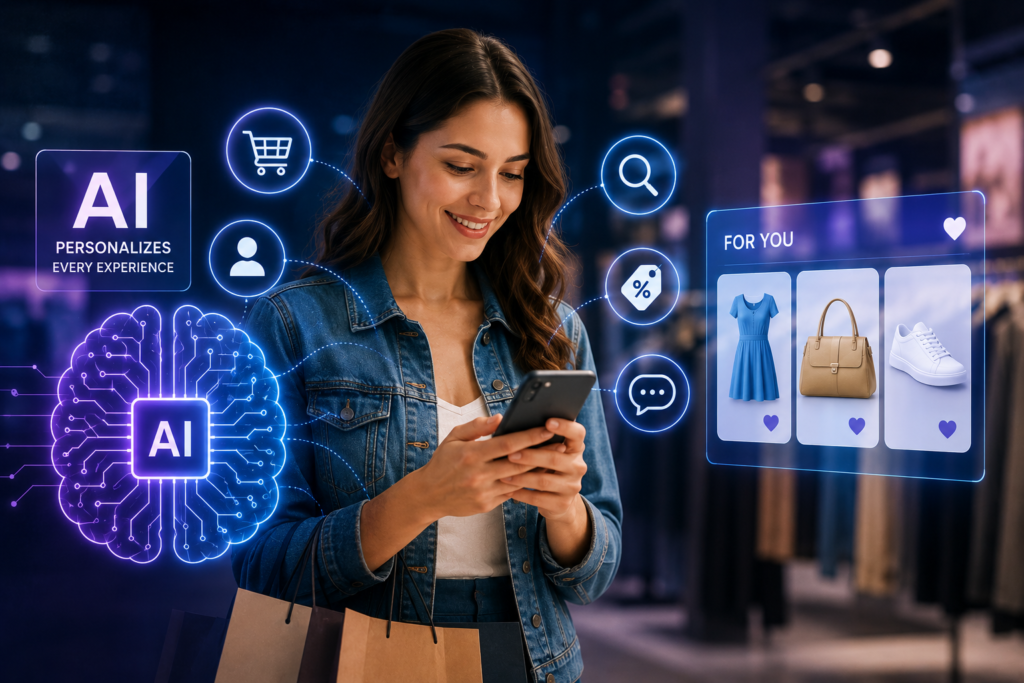
Why Personalisation Matters More Than Ever
Modern consumers have endless choices. If they cannot quickly find what they want, they often move to another retailer.
Personalisation helps retailers reduce this friction by showing customers products, content, and promotions that match their interests.
Today’s shoppers expect retailers to understand:
- Their shopping preferences
- Previous purchases
- Favourite brands
- Preferred communication channels
- Shopping habits
- Delivery preferences
When these expectations are met, customers are more likely to return, recommend the brand, and spend more over time.
Personalisation has shifted from being a competitive advantage to becoming a basic customer expectation.
How AI Personalises Every Stage of the Customer Journey
1. Intelligent Product Recommendations
One of the most common applications of AI in retail is personalised product recommendations.
Recommendation engines analyse customer behaviour and suggest products based on:
- Purchase history
- Browsing activity
- Similar customer interests
- Seasonal trends
- Popular combinations
These recommendations appear throughout the shopping journey, including homepages, category pages, product pages, shopping carts, and email campaigns.
The result is a more relevant shopping experience and increased average order value.
2. Personalised Search Results
Customers often leave websites because they cannot find the products they need.
AI-powered search understands customer intent rather than relying only on exact keywords.
For example, if someone searches for “comfortable office shoes,” AI can recommend suitable products even if those exact words do not appear in the product title.
This creates faster and more satisfying shopping experiences.
3. Dynamic Content Personalisation
AI allows retailers to customize website content for every visitor.
Different customers may see:
- Different homepage banners
- Personalised product collections
- Region-specific promotions
- Relevant blog articles
- Custom landing pages
This makes each visit feel tailored to individual interests.
4. Conversational AI and Virtual Shopping Assistants
AI chatbots have evolved beyond answering basic questions.
Modern conversational AI can:
- Recommend products
- Answer sizing questions
- Compare products
- Track orders
- Suggest complementary items
- Handle returns
These virtual assistants provide instant support while reducing pressure on customer service teams.
5. Personalised Marketing Campaigns
AI analyses customer behaviour to determine:
- Best email timing
- Preferred communication channels
- Product interests
- Purchase likelihood
- Customer lifetime value
Instead of sending identical promotions to everyone, retailers can deliver highly relevant campaigns that improve engagement and conversion rates.
6. Predictive Shopping Experiences
Predictive analytics helps retailers anticipate customer needs before they actively search.
AI identifies purchasing patterns and recommends products based on previous buying cycles.
For example:
- Replenishing skincare products
- Seasonal fashion recommendations
- Grocery restocking reminders
- Holiday gift suggestions
These proactive recommendations improve convenience while increasing repeat purchases.
7. Omnichannel Personalisation
Customers move between websites, mobile apps, physical stores, and social commerce platforms.
AI creates a connected customer profile across every touchpoint, allowing retailers to deliver consistent experiences regardless of where customers shop.
This means customers receive personalized experiences whether they browse online, shop in-store, or interact through mobile apps.
8. Loyalty Programme Optimisation
Traditional loyalty programmes reward all customers similarly.
AI helps retailers personalise rewards based on customer behaviour.
Examples include:
- Individual discounts
- Product recommendations
- Birthday rewards
- Exclusive offers
- Early access to new collections
This increases customer engagement and retention.
Real-World Examples of AI in Retail
Leading retailers around the world are using AI to improve customer experiences.
Fashion Retail
Fashion retailers use AI to recommend outfits based on previous purchases, preferred colours, body measurements, and seasonal trends.
Virtual fitting technologies also help customers visualise products before buying.
Grocery
Supermarkets use predictive analytics to personalise offers based on shopping frequency and household preferences.
Customers receive discounts that are relevant to their buying habits.
Beauty
Beauty brands use AI-powered skin analysis tools to recommend skincare products based on uploaded photos and customer concerns.
This creates a personalized consultation experience online.
Home and Furniture
Furniture retailers use AI to recommend complementary products while offering augmented reality experiences that help customers visualise products in their homes.
Business Benefits of AI Personalisation
Retailers implementing AI-driven personalisation often experience measurable business improvements.
Higher Conversion Rates
Relevant recommendations encourage customers to complete purchases rather than abandon their shopping journeys.
Increased Customer Loyalty
Customers are more likely to return when shopping experiences feel personalised and convenient.
Improved Customer Satisfaction
Fast product discovery, relevant recommendations, and responsive support create better customer experiences.
Better Marketing Performance
Personalised campaigns improve open rates, click-through rates, and return on marketing investment.
Higher Average Order Value
AI recommends complementary products and bundles, encouraging larger purchases.
Better Inventory Planning
Predictive analytics helps retailers understand future demand, reducing stock shortages and excess inventory.
Challenges Retailers Must Address
While AI offers significant opportunities, successful implementation requires careful planning.
Data Privacy
Retailers must handle customer data responsibly and comply with privacy regulations.
Transparency builds customer trust.
Data Quality
AI performs best when supported by accurate, complete, and up-to-date customer data.
Poor-quality data leads to poor recommendations.
System Integration
Many retailers operate multiple systems across ecommerce, CRM, marketing, and inventory.
Integrating these platforms is essential for creating a unified customer experience.
Human Oversight
AI should support employees rather than replace human expertise.
Retail teams remain essential for strategy, customer relationships, and decision-making.
Future Trends in AI Retail Personalisation
The next generation of retail AI will move beyond recommendations.
Emerging trends include:
- Generative AI shopping assistants
- Voice commerce
- AI-powered visual search
- Hyper-personalised pricing
- Autonomous merchandising
- Predictive inventory management
- AI-generated product descriptions
- Personalised video commerce
- Intelligent loyalty programmes
- Digital shopping companions
These innovations will make retail experiences even more personalised while helping businesses improve efficiency.
How Retail Leaders Can Prepare
Retail leaders should begin by evaluating where AI can create the greatest value for both customers and the business.
Key priorities include:
- Building a strong first-party data strategy
- Investing in AI-ready technology platforms
- Creating seamless omnichannel experiences
- Training teams to work alongside AI tools
- Measuring customer experience beyond sales metrics
- Continuously testing and refining personalisation strategies
Organisations that approach AI strategically will be better positioned to meet evolving customer expectations and stay competitive.
Conclusion
Artificial intelligence is transforming retail customer experience by making shopping more personalised, relevant, and convenient.
From intelligent recommendations and predictive analytics to conversational AI and omnichannel personalisation, AI is helping retailers strengthen customer relationships while improving business performance.
As customer expectations continue to rise, personalisation will remain one of the most important drivers of retail success. Retailers that invest in responsible AI, quality data, and customer-centric strategies will be better equipped to deliver memorable shopping experiences and achieve long-term growth.
If you’re looking to explore the latest innovations in AI, customer experience, and retail transformation, the NexGen Retail Summit brings together senior retail executives, technology leaders, and digital innovators to share practical insights, real-world case studies, and strategies shaping the future of retail.
Frequently Asked Questions
How is AI used in retail customer experience?
AI helps retailers personalise recommendations, automate customer service, improve search, optimise marketing campaigns, and create seamless omnichannel shopping experiences.
What are the benefits of AI in retail?
AI improves customer satisfaction, increases conversion rates, boosts customer loyalty, enhances marketing performance, and supports better inventory management.
What is AI personalisation in retail?
AI personalisation uses customer data and machine learning to deliver tailored recommendations, promotions, and shopping experiences based on individual preferences and behaviour.
What is the future of AI in retail?
Future developments include generative AI shopping assistants, predictive commerce, visual search, voice shopping, hyper-personalised marketing, and autonomous retail operations.